Can You Really Love Someone Who Hates Your Favorite Album?
Can You Really Love Someone Who Hate Your Favorite Album?
Let's set the scene. It's three months into a relationship that's going pretty well. You're in their car for the first time, they plug in their phone, and what comes out of the speakers stops you cold. Not bad, necessarily. Just… wrong. Fundamentally, inexplicably wrong in a way you can't quite articulate but immediately, viscerally feel.
You laugh it off. You say nothing. But something small and real has shifted.
If this sounds familiar, you're not being dramatic. And you're definitely not alone.
Music Taste Is Identity Taste
Here's the thing that makes musical incompatibility more loaded than, say, disagreeing about pizza toppings: music isn't just preference. For most people who care about it at all, it's a direct expression of who they are — their emotional landscape, their cultural reference points, their values, their history.
When someone tells you their favorite album is Blonde by Frank Ocean, they're not just telling you about their streaming habits. They're telling you something about how they process emotion, about the kind of complexity they find beautiful, about the cultural conversations they want to be part of. Same with the person whose go-to is a mid-2000s country playlist, or a hyperpop deep cut, or classic jazz from the 1950s.
Social scientists who study cultural consumption in relationships have a term for this: homophily, the tendency for people to form connections with others who share similar tastes and values. And while it's most commonly discussed in terms of politics or religion, research consistently shows that musical taste is one of the stronger predictors of social bonding — and, by extension, romantic compatibility.
"Music functions as a kind of cultural shorthand," explains Dr. Lauren Ferrante, a social psychologist who studies identity and consumer behavior. "When you share taste with someone, you're often signaling shared emotional vocabulary. When you don't, there can be a subtle but persistent sense of translation happening — like you're always having to explain yourself."
The Streaming Era Complicates Everything
Before algorithms, musical overlap in a relationship was partly a function of proximity. You listened to what was on the radio, what your friends were playing, what was in the cultural air. Shared taste was partly manufactured by shared environment.
Now, every person walks around with a completely personalized sonic universe in their pocket. Your Spotify Wrapped is a portrait of your inner life that's more revealing than most things you'd voluntarily share on a first date. And because our algorithms reinforce and deepen our existing tastes rather than challenge them, the gaps between people's musical worlds can be genuinely vast — even between people who grew up in the same city, went to the same schools, and share most of the same surface-level cultural references.
This matters in relationships because music comes up constantly. Road trips. Dinner parties. Working from home together. The background of every quiet Tuesday evening. If your sonic worlds are fundamentally mismatched, that's a lot of negotiation — and a lot of small moments of aesthetic friction that can accumulate over time.
So Is It Actually a Red Flag?
Let's be real: calling music incompatibility a "red flag" is a stretch in most cases. Plenty of wildly happy couples have completely different playlists. Plenty of people who share identical music taste make each other miserable.
But there's a more nuanced version of the question worth asking. It's not really "do you like the same songs?" — it's "do you have compatible relationships with music?"
Someone who treats music as pure background noise and someone for whom music is a near-spiritual practice are going to have friction that goes beyond playlist disagreements. It's a difference in how they process emotion, how they relate to culture, how they want to spend their Saturday mornings. The music is just the surface.
Similarly, someone who needs total control of the aux cord and someone who genuinely doesn't care what's playing are navigating a power dynamic that shows up in other places too. And someone who makes fun of your taste — not playfully, but dismissively — is telling you something important about how they handle difference in general.
The Playlist Test Nobody Talks About
Relationship therapists and dating coaches have quietly started using music as a diagnostic tool, and for good reason. Asking someone to share a playlist they love — and then actually listening to it — reveals more than most standard getting-to-know-you conversations.
Does the playlist surprise you? Does it make you curious about them? Or does it make you feel like you're looking at a stranger?
More importantly: how do they respond to yours? Are they genuinely interested, even if it's not their thing? Do they ask questions? Or do they immediately make a face and reach for their phone?
The content matters less than the dynamic. Two people with completely different tastes who are genuinely curious about each other's worlds can build something beautiful. Two people with identical Spotify libraries who are both defensive and dismissive about anything outside their comfort zone are in trouble.
When the Music Breaks Up Before You Do
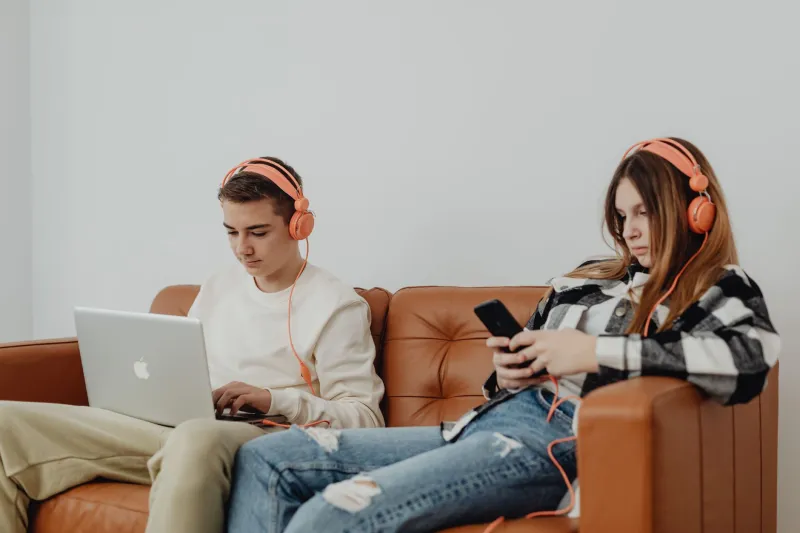
There's a specific phenomenon that longtime couples report: the gradual divergence of musical taste over the course of a relationship. It doesn't happen all at once. It's the slow drift of separate algorithms, separate headphone habits, separate emotional journeys that music reflects back at you.
Some couples treat this as a feature. They maintain distinct musical identities and come together around shared favorites, the way you might have your own friends and also mutual friends. Others find it disorienting — a symptom of a broader growing-apart that shows up in the playlist before it shows up anywhere else.
Either way, paying attention to it is worth something. Music is one of the most honest things about a person. It's hard to fake what moves you.
The Bottom Line
You don't have to date someone with identical taste. You probably shouldn't — musical monocultures make for boring listening parties. But the next time you find yourself in the passenger seat, quietly horrified by what's coming out of the speakers, it's worth sitting with the feeling for a minute before you laugh it off.
Not because the wrong playlist is a dealbreaker. But because what music reveals about a person — how they feel, what they value, how they handle being challenged — that stuff tends to matter quite a bit.
Your paradise is a vibe. Make sure you're building it with someone who gets what that means.